
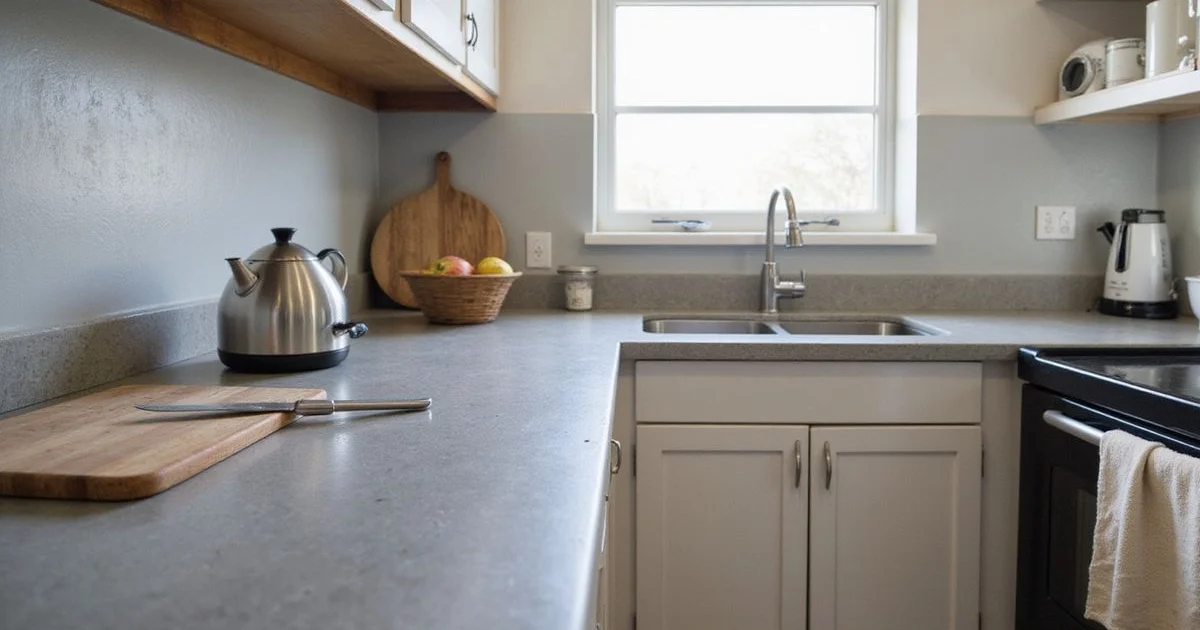
What Resurfacing Is
Countertop resurfacing builds a thin concrete look finish over the countertop you already have. The existing counter stays in place, and we prep its surface and put the new finish on in coats. The edges and cutouts get finished by hand, and then it gets a sealer made for kitchen use.
People use “concrete countertops” for two different services, so the difference matters. One is new concrete tops that are cast and installed. The other is a finish put over the counters you already have. Our countertop resurfacing service is the second one, and we say that up front instead of letting the mixup work in our favor.
What Makes a Counter a Good Fit
Three things have to be true.
It has to be solid. The counter needs to be fixed down properly, with no flex. If it moves when you lean on it, a thin layer stuck to it will move too and crack sooner or later.
The surface has to come clean. Years of cooking oils, cleaning products, and polishes have to come off before anything will bond. Degreasing and roughing up the surface are the difference between a finish that lasts and one that lifts at an edge.
There can't be hidden damage. Water damage around a sink, swelling at a joint, or layers coming apart underneath all rule out resurfacing. The new layer takes on whatever problem is below it.
We check whether your counter is a good fit before we quote, not halfway through the job. If we find hidden damage once work starts, we talk it through with you before we go on.
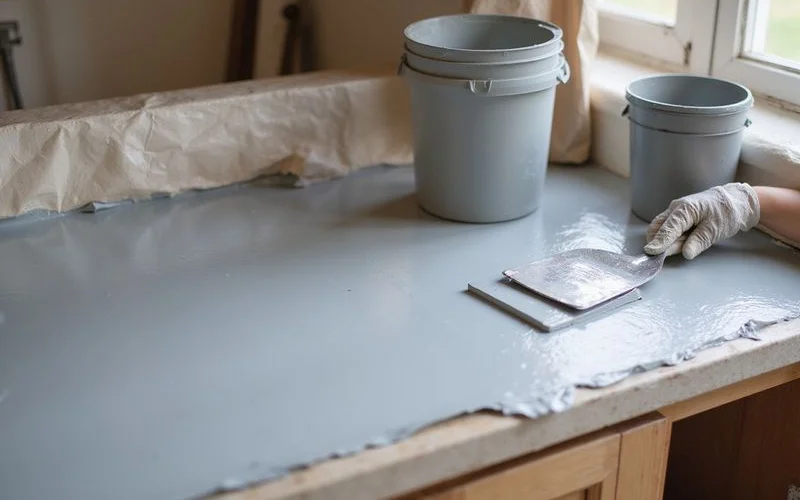
How the Job Goes
Prep comes first: cleaning, degreasing, roughing up the surface, and taping off the kitchen so dust and product stay where they belong. Then we build up the coats and work them to the finish you picked.
Edges, side pieces, and cutouts take most of the skilled hand work. These are the parts you touch every day and look at up close, and they can't be rushed. Sink and cooktop cutouts take a lot of work for how small they are.
Last, the sealer goes on. Then it has to cure before you can use the counter normally again. You can usually start light use before full use. Your proposal gives estimated dates for both, and the result depends on following the care and cure guidance we go over with you.
This is worth saying twice
Resurfacing changes the surface. It doesn't change how the counter is built, what's under it, or the layout. If a counter is falling apart, sagging, or water damaged, replace it. We'll tell you that plainly.
Your Finish and Sealer Choices
Concrete look finishes run from a smooth, even, modern surface to one with lots of shade variation and character. Neither one is the wrong choice. It comes down to how much variation you want in a kitchen you cook in every day.
The sealer is the bigger decision. A counter works harder than any other flat surface in the house. It gets hit with acid (lemon juice, vinegar, tomato sauce), heat, oil, knives, and constant cleaning. We choose the sealer based on how you cook and clean, and your written proposal lists it. When the job is done, we walk you through care for that product, and you can read more in caring for resurfaced concrete countertops.
Planning Around the Kitchen
Once people know their counter will work, most of them ask the same thing. How long will the kitchen be out of commission? The work typically takes several days, depending on the size of the kitchen, the number of coats, and how much edge and cutout detail there is. And after that, the sealer needs time to cure. You can't skip it, and it's the step people most often try to cut short.
There are usually two dates to know. Light use is when you can set things on the counter and use the kitchen carefully. Full use is when the counter is ready for normal cooking, cleaning, and everything else. Those dates can be several days apart.
Plan on the work area being taped off and the kitchen being only partly usable the whole time. Clear the counters completely (the coffee maker and knife block count too), and figure out ahead of time where those appliances will live until the job is done.
If other trades are working in the kitchen, the order matters. Book resurfacing after the dusty work is done and before the kitchen goes back into everyday use. Getting that order right keeps a finished counter from being used as a workbench.
What to Expect Day to Day
The finished counter looks like concrete, with a little movement and variation. It typically holds up well with reasonable care and normal kitchen use. But it isn't indestructible. Heat marks, deep scratches, and acid etching need a real repair, not a wipe down.
Treat it the way you’d treat a natural stone counter. Use trivets under hot pans, wipe up spills quickly, and use a neutral cleaner that won’t hurt the sealer. Those aren’t optional. They’re how the finish keeps looking right. If questions or concerns come up after the job, reach out and we'll talk it through.
Can We Do Your Counter?
We don't take every countertop job. Before we quote, we check that the base underneath is solid, look at our schedule, and pick the right system. If your counter isn’t a good fit, we’ll tell you and point you toward what might work better.