

Why Quotes Are Hard to Compare
Three quotes for stained concrete floors can be far apart, and every one of them can be honest. They’re pricing different work.
There’s no standard scope in this trade. “Stained concrete floor” can mean a full removal, grind, repair, test, stain, and two coats of sealer. Or it can mean a clean and a spray. Both look the same on an invoice. We wrote this guide to help you see the difference before you sign, not after.
If you haven’t read what drives the cost yet, start there. Once you know what moves the price, the questions below make a lot more sense.
Six Questions to Ask Every Contractor
1. What prep is included, and what happens if you find a problem?
Pulling up the old floor, grinding the surface, and getting the old glue off are most of the work. Ask if they grind with a machine and how many passes they make. Ask what they do if something unexpected turns up under the old flooring. Surprises under tile are common, so a clear answer here matters.
2. Will you run a test area on the slab first?
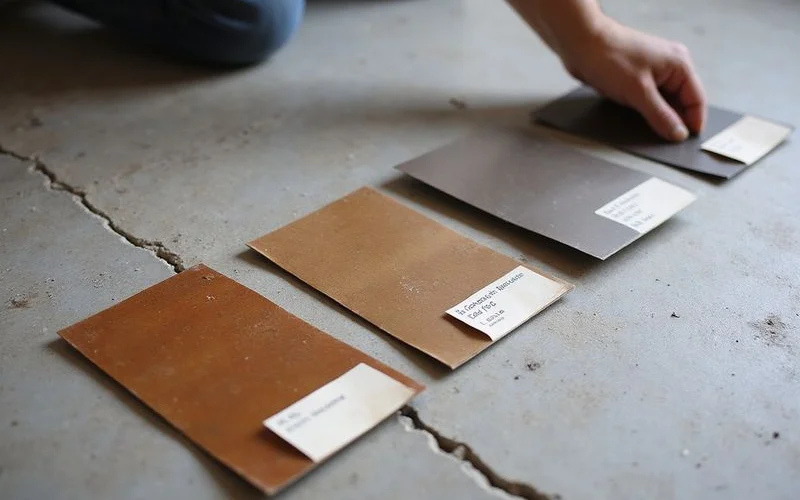
Acid stain reacts with what’s in your concrete. A test area is the closest preview you'll get. It doesn’t take long, so if a quote leaves it out, ask why.
3. Which products, and how many sealer coats?
You want product names, not product types. The sealer you pick sets the shine, the grip, the upkeep, and the cost. So check that the number of coats is written down.
4. What’s left out, and is there a minimum charge?
What’s left out is where quotes often differ: moving furniture, protecting baseboards, crack repair, the strips between rooms, and hauling off the old flooring. Ask for that list in writing.
5. What does the warranty actually cover?
A workmanship warranty covers mistakes in how the product was put down. That’s a lot different from covering how the floor will look in five years. Ask what is and isn’t covered, mostly around wear, color change, and failures caused by moisture. Those terms belong in the signed written proposal.
6. Do you have photos of jobs like this one?
Ask for their own work, not stock photos (ideally on a slab in about the same shape as yours). If all their photos show clean slabs in brand new homes and yours is a 1970s house with patched trenches, those photos won’t tell you much.
What to watch for
Be wary of any quote given without questions about what’s on the floor now, what’s under it, or past moisture problems. That quote covers a product, not your project, and it may change on site.
How to Read a Written Scope
A good scope spells it out on paper. It says what gets pulled up and hauled off, how the slab is prepped, and which repairs are included. It names the product and color plan, plus which sealer and how many coats. Look for the access and clear space the crew needs, what’s left out, the estimated schedule, and the payment terms.
If a quote is one line and a number, ask for the details before you compare it to anything. Most contractors will send them.
If they don’t, weigh that when you compare.
Check the Basics
Check that the business is who you think it is. Ask if they carry the right insurance for work inside your home, and what equipment they'll use to keep dust down in your space. Grinding concrete makes fine dust, so keep your family and pets out of the work area until cleanup is done.
Ask for references, and call one if it’s a big job. When you do, find out what went wrong on that job and how they handled it. Every job hits a snag somewhere, and how they answer tells you more than a five star rating does.
What We’d Say About Ourselves
We publish our editorial and evidence standards for anyone to read. We quote from your slab, not from an average. And if your floor isn’t a good fit for staining, our practice is to tell you, even when that costs us the job.
We don’t post made up reviews or borrowed before and after photos. So our proof may look thinner online than you’d expect. We made that trade on purpose. Judge us on our advice and on the questions we ask before we quote.